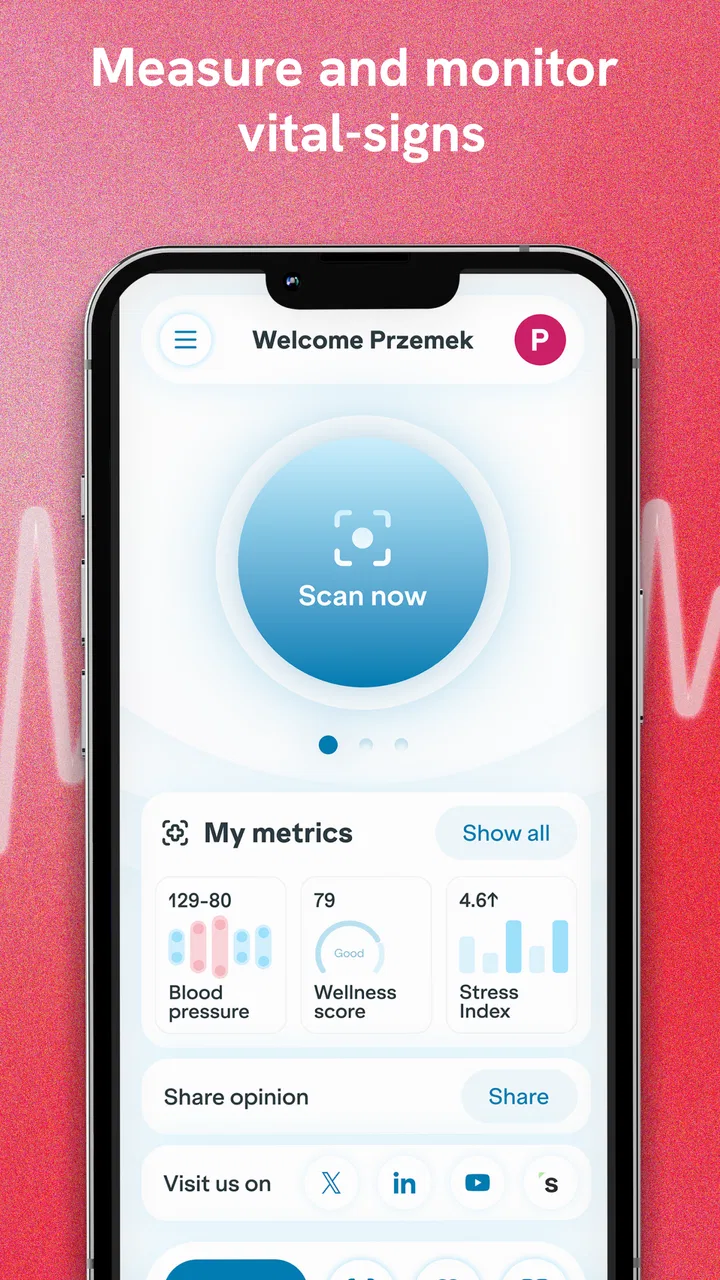
Heart Monitor: Measure BP & HR
- 4.5
- Rating
- 100.00K
- Installs
- Free
- Price

 Analysis by App-foxy
I approached Heart Monitor: Measure BP & HR as a companion for people who want to pay closer attention to everyday heart-related readings, not as a substitute for medical equipment or professional care. Developed by Shen.AI, this free medical app is aimed at checking and tracking blood pressure and heart rate in a way that fits around ordinary routines. That basic idea is appealing, especially if you already like keeping personal health information organized, but the usefulness depends heavily on how carefully you interpret what the app shows and how consistently you use it.
Start with a clear reason to track
Before I would make any health-tracking app part of my routine, I would decide what question I want the record to help answer. Am I trying to remember readings for an appointment, follow a pattern that my clinician asked me to monitor, or simply become more attentive to my health? A specific purpose helps keep checking useful rather than turning it into a source of worry.
My first impression is that the app makes most sense as a logging and awareness tool. A single reading rarely tells the whole story, while a series of readings taken under similar conditions can help you notice patterns worth discussing with a doctor. The important distinction is that convenience should not be confused with clinical certainty. I would use this app to support a conversation about my health, not to make a diagnosis or change medication without medical advice.
You May Also Like

 Blood Strike: 2.5 Anniversary
Blood Strike’s Loadouts Turn Every Drop Into a Tactical Gamble
A close look at Blood Strike’s custom loadouts: how fast access to signature weapons reshapes its battle royale rhythm, rewards preparation, and narrows the gap between fights.

 Pandora - Music & Podcasts
Pandora’s Music Is Easy to Start, but Harder to Recover
Pandora’s strength is its low-effort path from a seed to a station. Its weak spot is how much confidence it asks you to place in connection, setup, and quiet recovery.

 8 Ball Pool
 Is Built on Rivalries, Rematches, and Routine
A close look at the rivalries, rematches, shared routines, and unanswered safety questions that turn a quick pool match into a persistent mobile community.

 Samsung Music
’s Quiet Strength Is Playing What You Already Own
Its reach comes less from spectacle than from dependable access to a personal library. That simplicity is both the app’s strongest retention engine and its ceiling.

 AccuWeather: Weather Radar
AccuWeather Review: A Quick, Clear Forecast for Everyday Decisions
For everyday plans, the best forecast is the one you can understand quickly. AccuWeather makes rain timing, radar, and local conditions easy to act on, with a few trade-offs.

 Hill Climb Racing
Why Hill Climb Racing Still Turns Crashes Into One More Run
A tiny car, a bumpy hill and one more upgrade: Hill Climb Racing keeps resurfacing because its simple chaos makes every near-miss feel personal.
More From Our News Desk



How Heart Monitor fits into real daily routines
I think the most useful way to bring a phone-based health record into daily life is to tie it to a specific moment, rather than checking whenever a worry pops up. A calm, repeatable routine makes it easier to compare like with like and gives me a clearer handoff from personal tracking to a clinician’s advice. From there, the practical question is how to make that routine manageable on an ordinary day.
The value of a connected health check
Connectivity shapes the experience in a practical way. When the app can communicate normally with its surrounding services, the process feels more like a continuing record than a one-off glance at a number. That matters because health tracking works best when readings remain connected to a routine: after waking up, before an appointment, or during a period when you are trying to understand how your habits affect you.
I find this especially useful for preparing information before speaking with a healthcare professional. Instead of relying on memory, I can look back at the readings I chose to record and describe the circumstances around them. That context is often more useful than an isolated result. For example, a number taken immediately after rushing through a commute should not automatically be treated as equivalent to one taken after sitting quietly.
The network-dependent moments are also where expectations need to stay realistic. A connected app can make an account or record feel accessible across a broader digital routine, but it does not remove the need for a reliable measurement method. Internet access cannot correct a rushed reading, an unsuitable device, or a misunderstanding of what a result means. The strongest workflow is still careful measurement first, followed by thoughtful recording and review.
Using it away from the ideal setup
The app is most attractive to people who want health tracking available on a phone rather than in a separate notebook. That makes it convenient in mobile contexts: at home, before leaving for work, or while preparing questions for a medical visit. I can imagine opening it during a calm part of the day, entering or checking a result, and then returning to the rest of my routine without turning the process into a major project.
Still, a phone is not automatically the ideal place for every health task. Small screens can make it harder to compare several readings, and a busy environment can encourage careless entries. If I were using the app during travel or in a waiting room, I would treat that as a reminder to organize information, not as permission to take a hurried measurement. The best mobile use is deliberate: sit down, reduce distractions, and make sure I know which reading I am recording.
One practical habit is to create a repeatable moment for checking. I would choose a time when interruptions are unlikely, keep the measurement method consistent, and add enough personal context to recognize unusual circumstances later. This turns the phone from a passive display into a small part of a health routine. It also reduces the temptation to react emotionally to every change.
What happens when the connection or routine breaks
Every connected health experience has moments when the surrounding technology is less cooperative. A weak network, an interrupted session, or a rushed day can break the rhythm of tracking. I would not consider that a reason to panic, but I would avoid filling gaps with guesses. If a reading is not properly recorded, it is better to wait for a suitable opportunity than to create a misleading entry simply to keep a sequence looking complete.
Recovery should begin with the basics. I would check whether the phone is connected as expected, reopen the app, and confirm that the relevant reading is present before moving on. If the problem involves the measurement itself, I would repeat it only after settling down and following the same careful process used previously. Repeating readings immediately out of frustration can produce a confusing string of results rather than a clearer answer.
This is one of the app’s important trade-offs. A digital record is easier to revisit than loose notes, but it can also make people expect every health interaction to be instant and seamless. In reality, reliable tracking sometimes requires patience. If the app is being used alongside a separate blood-pressure monitor, I would keep the monitor’s instructions as the authority for taking the reading and use the phone to help organize the information afterward.
For urgent symptoms, recovery from a technical problem is not the priority. Severe chest discomfort, difficulty breathing, fainting, sudden weakness, or another alarming change deserves appropriate medical attention rather than troubleshooting an app. The same applies if a result seems dangerously unusual. A health app can support communication, but it should never delay urgent care.
Reading numbers without overreacting
The most responsible way to use this app is to think in trends and context. Blood pressure and heart rate can vary for many ordinary reasons, including activity, stress, caffeine, illness, rest, and the timing of a measurement. That does not make the readings meaningless; it means they need to be collected in a consistent way and interpreted with care.
I would avoid treating the app as a diagnosis engine. Its role is better understood as a personal tracking layer. If I noticed repeated readings that concerned me, I would bring the record to a clinician and ask what it means in my situation. That approach is more useful than searching for a single “good” number and judging myself against it without considering age, medical history, medication, or the method used.
A subtle but valuable workflow is to write down the reason for an unusual reading while it is still fresh. I might note that I had just exercised, slept poorly, felt anxious, or had taken a prescribed medicine. Those details can prevent me from misreading a temporary change as a long-term trend. They also give a healthcare professional more useful material than a bare list of figures.
Privacy-minded habits for personal health information
Health information deserves more care than an ordinary shopping list or fitness note. I would avoid sharing screenshots casually, especially when they include identifying details. If someone else needs to see the record, I would show only what is relevant to the conversation and remove unnecessary personal information where possible.
Connectivity makes this consideration more important, not less. A phone-based record is convenient, but convenience can encourage automatic sharing or careless access. I would review the app’s current privacy and account settings directly before relying on it for sensitive information, because those details can change over time. I would also keep my phone protected with the device security features I already trust.
Another data-conscious habit is keeping the record purposeful. I would not enter every passing sensation or repeatedly check my heart rate just because the app is available. Excessive checking can increase anxiety and make ordinary variation feel threatening. A simple schedule agreed with a healthcare professional is usually more sensible than constant monitoring.
Who will get the most from it?
I think this app is a good fit for an adult who wants a convenient way to follow blood-pressure and heart-rate information over time, particularly someone who tends to forget readings or arrives at appointments without a clear history. It may also suit a person helping a family member stay organized, provided the person being monitored understands what is being recorded and the information is handled respectfully.
The app is available at no upfront cost, which lowers the barrier to trying it. Its age classification is Everyone, so it is presented for a broad audience, but that does not mean every health situation is appropriate for self-tracking without guidance. Children, older adults with complex conditions, and people taking heart or blood-pressure medication should use extra care and involve a qualified professional when deciding how to interpret readings.
I would skip it if I wanted a replacement for a validated medical monitor, a diagnostic consultation, or emergency guidance. I would also choose another option if my main need were detailed clinical reporting, integration with a particular medical system, or a specialized device workflow that this app does not match. A notebook can be better for someone who dislikes connected services, while a dedicated monitor may be the better investment for anyone who needs dependable home measurements.
Choosing between a phone log and familiar alternatives
Compared with a paper notebook, a phone-based record is easier to carry and revisit when preparing for a conversation with a clinician. The notebook wins on simplicity and independence from network or account friction; it also lets you add context in your own words without needing to navigate a small screen. I would choose whichever option I could maintain accurately, rather than assuming digital is automatically better.
Compared with a dedicated blood-pressure monitor, this app belongs on the organization side of the workflow, not in place of a purpose-built measuring device. If dependable home readings are the priority, I would follow professional advice about selecting and using a suitable monitor, then use a record-keeping approach that makes those results easy to discuss. That distinction is especially important for someone who has been asked to monitor a condition or adjust care under medical supervision.
A realistic routine from reading to appointment
Imagine I have a check-up coming up and often forget what my readings were between visits. I would pick a calm, repeatable time, take a measurement using the appropriate method, and record it rather than relying on memory. If something unusual affected the result, I would note that context. Before the appointment, I would review the record and bring the points I want to ask about, instead of trying to interpret the numbers alone.
This workflow has a useful handoff: the app helps me keep information together, while the clinician supplies the interpretation. It also gives me a practical test of whether the app suits me. If recording takes more effort than I can sustain, or the screen does not help me find what I need, a simpler log may be the better choice. A tracking tool only helps when it fits the person’s real routine.
What the current release tells me
The app has been available since May 12, 2021, and its current version is 10.6.0. That history suggests an established product rather than a brand-new experiment, while the store presence shows over 100 thousand installs and an average rating of 4.5 from around 5.5 thousand ratings. I see those figures as signs that many people find the concept useful, but not as proof that it will suit every phone, measurement method, or medical need.
There are also optional purchases, ranging from about $2.49 to $269.99 per item. That wide range is worth noticing before committing to anything beyond the free starting point. I would first understand what I can do without paying, then decide whether an optional feature genuinely improves my routine. For a simple personal log, paying may not be necessary; for someone who values additional tools, the decision should depend on the exact feature and its ongoing usefulness rather than impulse.
My connectivity verdict
After looking at the app through the lens of real use, I see Heart Monitor: Measure BP & HR as a practical companion for organized self-monitoring, with connectivity acting as both its convenience and its main responsibility. It can help turn scattered readings into information that is easier to revisit, but it cannot make an unreliable measurement reliable or replace professional judgment.
I would recommend trying it to a friend who wants a simple mobile starting point for tracking blood pressure and heart rate, especially if that friend is willing to build a calm, repeatable routine. I would advise keeping a backup plan for interrupted sessions, protecting the information on the phone, and using a proper medical device when accurate measurement is important. The app is at its best when it supports good habits rather than encouraging constant checking.
My final view is positive but measured. Shen.AI has created something that can fit naturally into everyday health organization, and the free entry point makes experimentation easy. The right question is not whether a connected app can tell me everything about my heart. It is whether it helps me collect clearer information, notice useful patterns, and communicate more effectively with a healthcare professional. Used within those limits, this medical app earns a place in a careful personal tracking routine.
FAQs for Heart Monitor: Measure BP & HR
01Is Heart Monitor: Measure BP & HR accurate for measuring blood pressure and heart rate?
Heart Monitor: Measure BP & HR uses advanced algorithms to estimate your blood pressure and heart rate. While it provides convenient measurements, it should not replace professional medical devices. For medical advice or diagnosis, always consult a healthcare professional. The app is designed for informational and educational purposes only.
02Can I use Heart Monitor: Measure BP & HR without an internet connection?
Yes, you can measure your heart rate and blood pressure without an internet connection using Heart Monitor. However, some features like data backup, syncing with other devices, or accessing online resources may require internet connectivity. Check the app’s settings to see which functionalities need internet access.
03Does Heart Monitor: Measure BP & HR store my personal health data securely?
Heart Monitor: Measure BP & HR takes data privacy seriously. It employs encryption to protect your personal health data. You have control over your data and can choose to delete it anytime. Always review the app’s privacy policy to understand how your data is handled and stored.
04Are there any additional costs or in-app purchases in Heart Monitor: Measure BP & HR?
The app offers a free version with basic features. However, there are optional in-app purchases for advanced features or ad-free experiences. Check the app’s store listing for detailed pricing information and decide if the premium features align with your needs before purchasing.
05How user-friendly is Heart Monitor: Measure BP & HR for beginners?
Heart Monitor: Measure BP & HR is designed with a user-friendly interface that is easy to navigate, making it accessible for beginners. The app includes tutorials and helpful tips to guide you through its features. If you encounter any difficulties, consult the app’s help section or customer support for assistance.
Pros
- User-friendly interface for easy navigation.
- Accurate heart rate tracking with real-time data.
- Customizable alerts for irregular readings.
- Integration with health apps like Google Fit.
- Detailed history logs for tracking progress.
Cons
- Limited features in the free version.
- Requires an internet connection for full functionality.
- Battery drain due to continuous monitoring.
- No support for older devices below Android 8.
- In-app ads can be distracting during use.

Heart Monitor: Measure BP & HR
Gallery